Home
He missed the train home. Perhaps that was not the worst thing that could have happened.

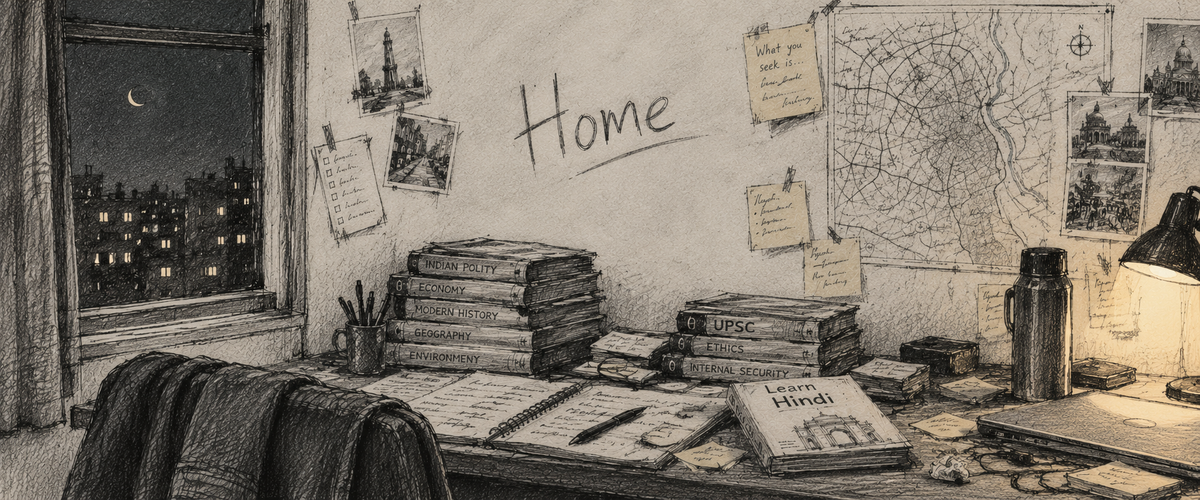
He missed the train.
His alarm hadn't gone off. Perhaps the cold had something to do with it. He wasn't used to winters like these. Back home, people complained about the cold while standing in the sun.
Here, it had found its way into the bones.
The language hadn’t helped either. He had spent nearly half an hour trying to explain where he wanted to go. By the time he made it, the train was gone.
The next one would cost him almost everything he had left.
He bought the ticket.
There wouldn't be much left for dinner.
The owner of the house had left for warmer skies a few days ago. He had a habit of sending something up when there was extra food at home. Nothing much. A bowl of dal. A few chapattis. It had always seemed like a small courtesy.
Tonight, there was no one to extend it.
He found a small place that would fit what was left in his pocket and bought himself a modest meal. He carried it back to his room.
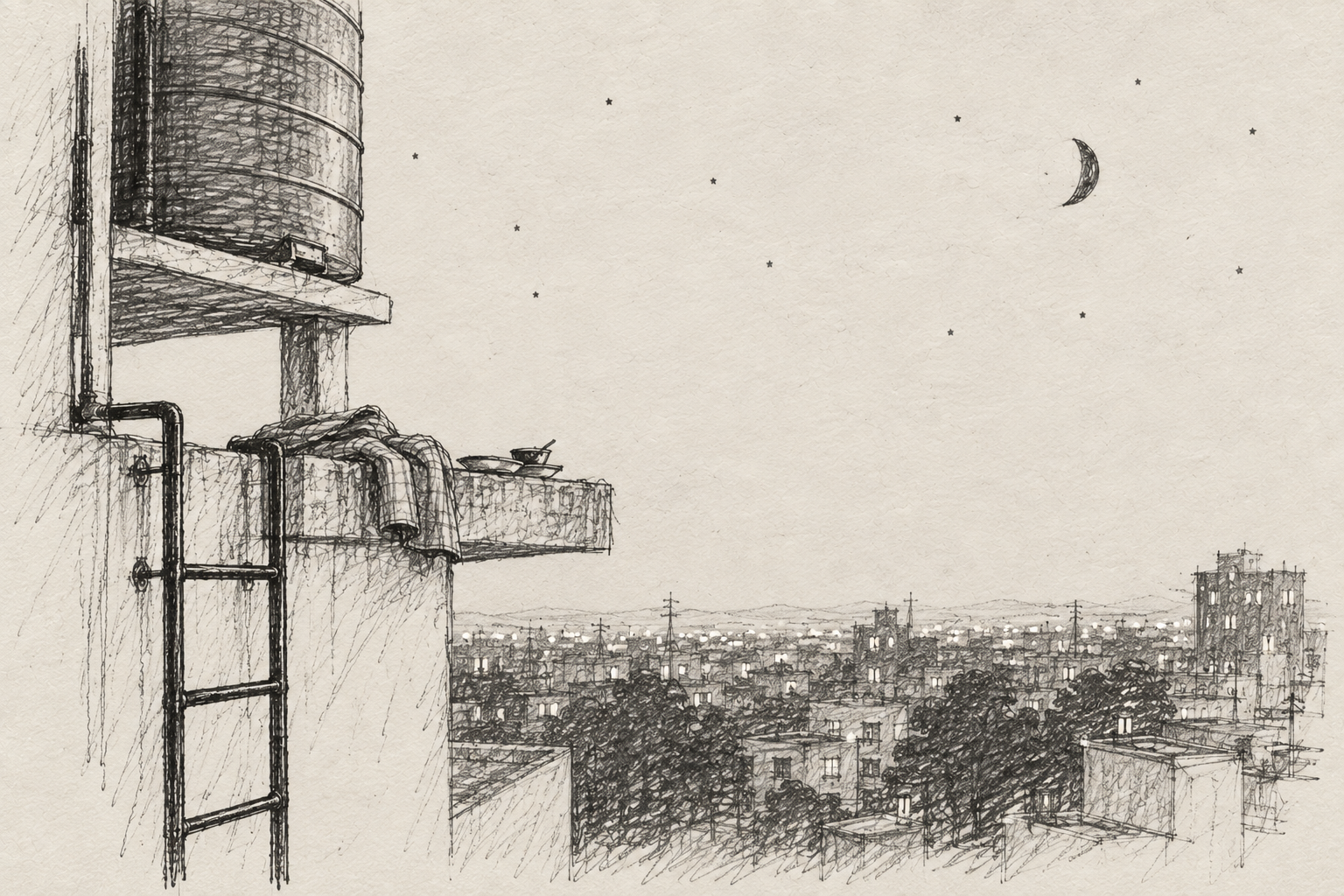
The room had once been meant for the house's servants. It was tucked away in one corner of the terrace, the only room up there. Above it sat the water tank. Beneath the tank was a little perch, overlooking the locality below.
He ate some of the meal in his room and carried the rest up.
He walked to the ladder a few yards from his door and climbed up to the perch. He wrapped a few extra layers around himself and settled in.
It was not particularly comfortable.
But it was somewhere to sit.
For tonight, that was enough.
Above him, the sky seemed impossibly large.
He had spent the last few months learning how different everything was here.
The language.
The roads.
The way people spoke.
The way they dressed.
The cold.
Even the silence felt different.
There was something ahead of him here that he couldn't quite name without making it smaller.
Someone, perhaps.
A life.
A possibility.
He had left behind a house that had known him all his life. People who knew what he liked to eat without asking. People who knew which version of him was angry and which version was merely tired.
He had left all of that behind to come here.
And maybe that's what people do.
They leave.
They learn new places.
They make new homes.
They become someone else's familiar.
Perhaps he could learn this place too.
One day, he wouldn't need half an hour to explain where he wanted to go.
He might know the roads well enough to get to the railway station without asking anyone.
He might ride the metro without checking the line twice, knowing when to get off and which way to walk once he did.
Maybe he would learn the winters too.
Which windows to keep shut.
How many layers were enough.
Where the warmth stayed in the house.
Small things.
Nothing he couldn't learn.
He had already acquired a taste for the food.
Perhaps the rest would come with time.
Given enough time, the things that felt foreign would simply become ordinary.
Perhaps even home.
He looked down at the food in his lap.
The chapatti had gone stiff.
He broke a piece and dipped it into the dal.
Then he looked over the edge of the perch.
It was a long way down.
For a moment, he imagined slipping.
Nothing dramatic.
Just a foot in the wrong place.
A moment's carelessness.
The body going over before the mind had time to catch up.
He imagined the fall before he could stop himself from imagining it.
Would anyone hear?
Would anyone find him?
How long would it take?
He wondered if he would still be alive when they did.
And then he wondered how long it would take for the news to reach his mother.
Someone would have to find him first.
Someone would have to make a call.
The person making it might not know his name.
They might simply say that a young man had fallen.
That he was badly injured.
That he hadn't made it.
An address.
A time.
A few details.
Information passed from one person to another until, somewhere at the end of it, his mother heard that her son was dead.
He looked around.
This place had no memory of him.
If something happened to him here, who would know?
His body might be sent home.
Perhaps it wouldn't.
One day, he might even be buried somewhere here.
A shallow grave in foreign soil.
A stone above.
His name carved into it in a language he probably wouldn't understand.
He imagined someone standing there years later, reading his name.
Perhaps they wouldn't even stop.
They would have no reason to.
The people who knew him would grow old.
Some would die.
The city would change.
The house he might have lived in would belong to someone else.
And he would remain there.
Under the same sky.
Only no one would know who lay beneath it.
He wondered how long it took for a person to disappear after they were gone.
Perhaps longer than death itself.
Perhaps not.
He thought about home.
A grave there would be different.
Somewhere among people who knew his family.
Someone might come across his name years later.
A family name.
A familiar place.
Someone might pause.
Who was he?
And someone else might know.
Someone might say, Oh, him.
They might remember something small.
The way he laughed.
Something foolish he had done.
The house he had grown up in.
Nothing important.
Just enough to make him, for a moment, more than a name on stone.
He looked up again.
The stars above him would be the same stars, probably.
He pulled the blanket tighter around himself.
The perch beneath him was temporary.
The night was temporary.
If everything went according to plan, he would leave tomorrow.
Or he wouldn't.
The dal had gone cold.